Neither One Is Permanent
Fat grafting retains an average of 47 percent. Filler persists at 27 months. What the retention data says about the choice you are being offered.
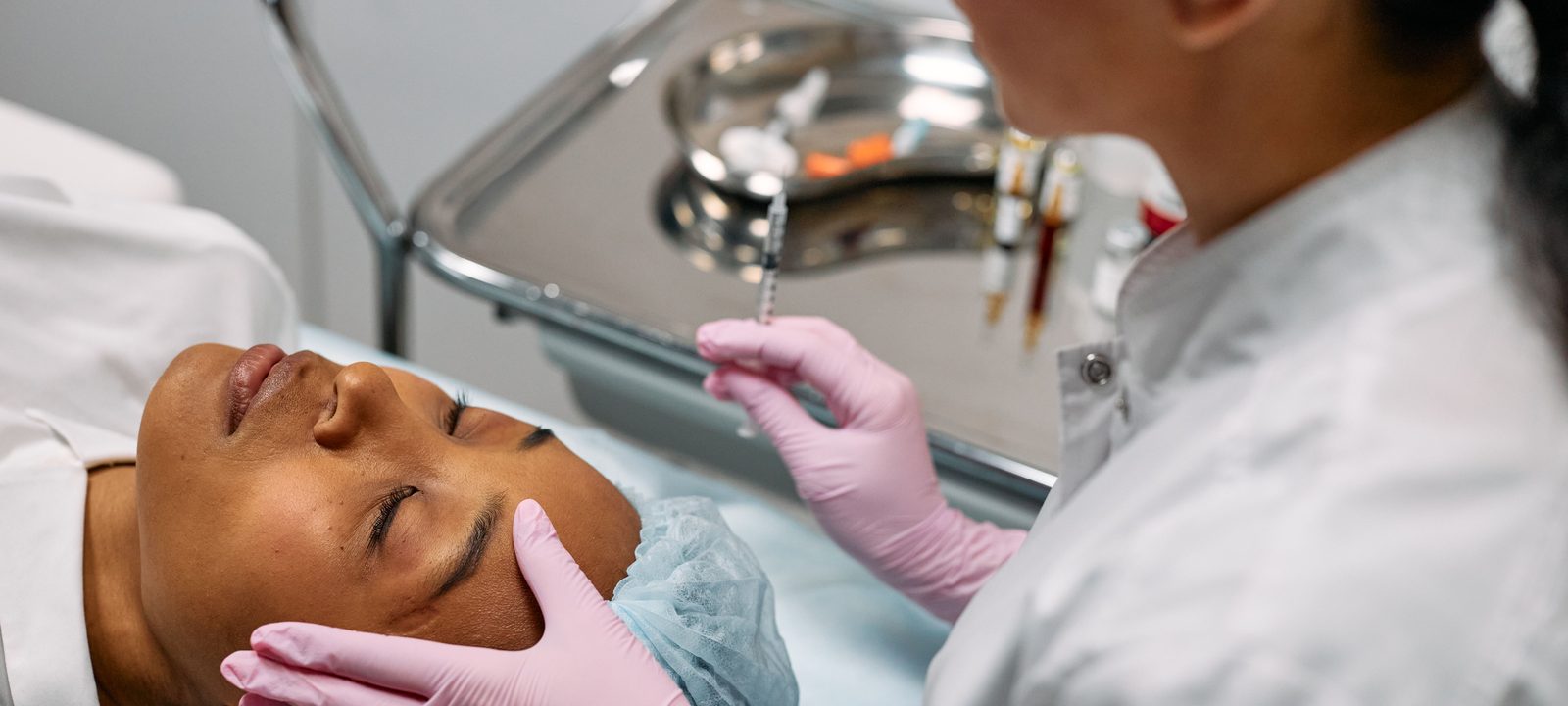
The consultation tends to present this as a clean choice. Filler is temporary and reversible. Fat grafting is your own tissue and lasts forever. Choose according to how committed you feel.
Both halves of that are wrong, and they are wrong in the same direction. Filler stays longer than you are told. Fat survives less predictably than you are told. In each case, the error points toward more treatment than you might otherwise agree to.
Here is what has been measured.
Why anything needs refilling
Because a face loses volume from two structures, and neither of them is skin.
Beneath the skin of a young face sit around eleven fat compartments on each side, plump and evenly distributed, cushioning the space between skin, muscle and bone. By the late sixties, most have diminished considerably. A few enlarge. The great majority shrink.
Beneath those, the bone itself recedes, particularly around the eye sockets and the jaw. The scaffolding everything else is draped over quietly withdraws.
What results is the same skin envelope over a smaller foundation. Refill addresses that specific deficit. It does nothing for skin quality, muscle activity or laxity, which is why it disappoints so reliably when deployed as a general solution.
Roughly half the fat survives
A review pooling twenty-seven studies and 1,011 patients found retention ranging from twenty-six to eighty-three percent, averaging forty-seven. The authors were blunt about the implication: how much survives is currently unpredictable, and reported figures vary considerably with the method used to measure them.
It varies by site too. In one cohort, the chin and lower lip retained most at around fifty-nine and fifty-six percent, while the nose retained least at thirty-nine, with cheeks near forty-eight.
The reason is straightforward. Grafted fat is transplanted living tissue arriving without a blood supply. Some of it dies before new vessels reach it. Part of the graft dies, part regenerates, part survives.
Technique matters less than the marketing around processing methods implies. Comparing the main approaches, retention came out at 41.00, 44.53 and 41.20 percent, and a systematic review could not identify any single method as superior. Enrichment looks more promising: non-enriched grafts averaged 41.63 percent against 65.68 for grafts enriched with stromal vascular fraction and sixty-nine for platelet-rich plasma, though those groups were small.
The more useful predictor is repetition. In a cohort of ninety-three patients followed for around three years, overall retention was fifty-three percent. Patients who had five or more sessions retained seventy-three percent. Those who had one retained forty-five.
That is a genuinely longevity-shaped finding. Grafting behaves more like a process than an event, and the women who treated it that way kept substantially more.
The permanence claim
It rests on an assumption nobody has verified.
The logic runs that fat surviving the first year has established a blood supply and will therefore stay, and follow-up conventionally stops at twelve months on that basis.
A five-year study examined the assumption directly and found no objective evidence that graft volume is stable after a year. In that study, measured volume had increased at five years, which sounds encouraging until you read the explanation: body weight change is a major confounder in measuring facial volume over long periods. The increase in visible volume came with no increase in satisfaction, which had returned to where it started.
Grafted fat is your fat. It responds to whatever the rest of your fat responds to.
Filler stays longer than advertised
MRI follow-up showed hyaluronic acid almost entirely gone from the chin at nineteen months while remaining clearly present in the lateral face and deep mid-face at twenty-seven. Broader reviews report considerably longer in some cases.
The consequence is well documented. Women were told filler lasts six to twelve months and returned for top-ups assuming the previous product had dissolved. The overfilled face is almost always cumulative rather than the result of one heavy session, and it comes from booking by calendar rather than by looking.
The same principle governs both materials: movement drives breakdown. Mobile regions clear product faster. Deeper, stiller compartments hold onto it.
So which
The comparison that matters is not permanence, since neither delivers it in the way it is described.
Filler goes in during a single appointment with no surgery, can be dissolved with hyaluronidase, and gives an immediate result. Its failure mode is accumulation: product lingering beyond expectation, layered beneath new product, building toward a face nobody chose.
Fat grafting requires liposuction to harvest, involves surgical recovery, delivers an unpredictable share of what went in, and generally needs repeating. Its failure mode is unpredictability and the influence of your weight across the following years. It is not reversible in the way filler is.
Both carry low complication rates in the published literature. One systematic review of facial fat grafting reported no deaths and no significant serious complications across the studies analysed.
Realistically: filler is the lower-commitment option provided you manage the interval honestly, and fat grafting rewards patience and repetition at the cost of predictability.
There is also a third category worth knowing about, because it reframes the question. Biostimulatory injectables provoke your own fibroblasts into producing collagen over subsequent months rather than adding volume directly. That gives a slower onset and a result that builds, and it sits closer to the Redrape lever than to Refill. Which matters, because some of what reads as deflation is loss of tissue quality rather than loss of bulk, and adding volume to a structural problem is one reliable route to a face that looks filled rather than restored.
Questions worth taking with you
Where exactly is it going, since placement decides persistence for filler and survival for fat. How much is still present from last time, and if the answer is a confident assertion that everything has gone, ask what it rests on. What triggers a top-up, where a visible threshold beats a date. How many sessions should I expect, and for fat grafting the honest answer is frequently several. And what is the plan if I want it reversed, where hearing the complication described accurately is a good sign.
Where this belongs
Under Refill, and it is the lever that most rewards restraint.
Assess before adding, because the question at each appointment is what is present now rather than how many months have elapsed. And recognise that Refill answers one question only. Volume loss is one of four mechanisms reshaping a face, alongside muscle activity, collagen decline and surface damage. A plan that keeps addressing volume while ignoring the rest produces the characteristic overfilled look: a face given a great deal of one thing and none of the others.
The most useful thing you can bring to a decision like this is an accurate picture of how your face has changed across recent years, rather than how it looks today against how you remember it looking. Memory is a poor instrument for gradual change in a face you see every morning, and that difficulty is precisely why booking by calendar feels reasonable when it is not.
FAQ
How much grafted fat survives?
Roughly 47 percent on average, and the range around that average is wide.
Is filler really temporary?
Less temporary than the consultation suggests. Hyaluronic acid has been imaged in the mid-face at 27 months.
Which should I choose?
Both need repeating, so the decision turns on how predictable you need the result to be and how much downtime you can take, rather than on permanence.
References
- Volume Retention After Facial Fat Grafting and Relevant Factors: A Systematic Review and Meta-analysis, Aesthetic Plastic Surgery, 2020. Full text.
- Long-Term Outcome of Fat Grafting to Treat Facial Systemic Sclerosis: A Prospective Cohort Study, Plastic and Reconstructive Surgery, 2025. Source of the repetition finding.
- Volume and patient satisfaction, 5 years of follow up after facial fat grafting, JPRAS, 2025.
- Long-Term MRI Follow-up of Hyaluronic Acid Dermal Filler, 2022.